CHALLENGES OF LATIN AMERICAN TOURISM: DEVELOPMENT PERSPECTIVES AND SOCIO-SPATIAL CONTRADICTIONS
Abstract
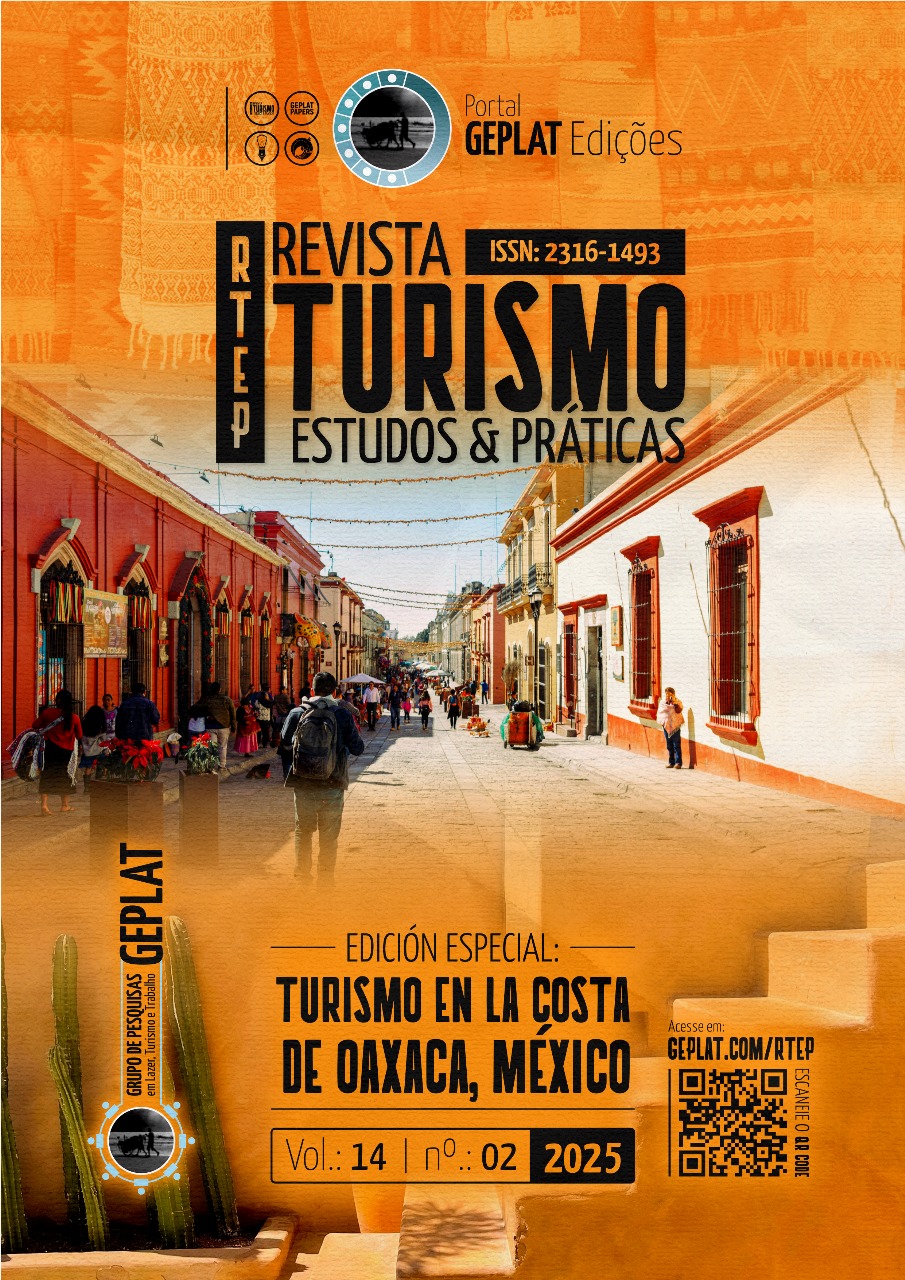
This special edition, dedicated to Tourism on the Oaxaca Coast, Mexico, presents the Journal of Tourism Studies and Practices (RTEP/GEPLAT/UERN) with another international volume, strengthening academic ties with distinguished Latin American researchers and opening new perspectives for thinking about tourism in our American continent based on empirical monographs and theoretical reflections that go beyond economic-managerial thinking. Therefore, valuing epistemological plurality and freedom and creativity in the critical perspective of emerging analytical objects and disruptive comprehensive frameworks, the collection of texts that follows presents the reader with the challenge of rethinking Tourism at the broad interface of Society, Culture, Space, Nature, Urban, Work, Technology, and Tradition. It is worth emphasizing, in effect, that Tourism on the Oaxaca Coast, Mexico sought to provoke more fertilization and cross-fertilization of ideas than conclusions and closures of debates.
Thus, in the present Volume 14, Number 2 (2025), organized by Professor Dr. José María Filgueiras Nodar, from the Institute of Tourism Research, Universidad del Mar (Huatulco campus), the reader is presented with a collection of critical texts on tourism at the dawn of a 21st century already in advanced consolidation, in such a way that these empirically and theoretically-methodologically grounded arguments are eager to problematize tourism activity as a resource for socio-spatial development, on the one hand; but which has demonstrated, on the other hand, a series of structural contradictions that limit its developmental capacity of yesteryear, that is, of the last five decades of the collapse of linear, managerial and trend-predictive thinking.
This edition, aiming to update a broad understanding of the theorization on tourism activities and their impacts on the construction of the social world, has the merit of fostering an active dialogue with Latin American thought on tourism, primarily Mexican authors, but above all it bears strong marks of Brazilian critical geography, notably marked by renowned names such as Milton Santos, Rogério Haesbaert, Roberto Lobato Correa, and Ana Fani Carlos. These authors promote an analytical bridge between the 20th century with its spaces of the large factory and the proletarian megalopolis and the 21st century of global financialized capitalism with its virtualized spaces of digital cities hyperconnected by networks of byte consumers and platformized workers.
In terms of themes, this edition also reveals emerging and urgent issues for tourism studies, such as concerns about neocolonialist perspectives in tourist destinations geared towards mass consumers of shop windows, parks, and facades for image-based celebration on social media; precarious work behind the scenes and on the stages of services aimed at the playful and childish satisfaction of tourists; the daily life on the streets and the almost militarized institutionalization of migrants adrift from tourism and in vulnerable situations; real estate speculation and gentrification reshaping urban spaces for the expansion and socio-metabolic reproduction of Capital; in addition to problematizing the socio-environmental impacts caused by tourism activities on local ecosystems and traditional communities through neo-extractive processes.
The opening article of this dossier – to which we devote greater attention in this preface – entitled EIGHTEEN YEARS OF SMELLS IN THE TOURIST DESTINATION OF BAHÍAS DE HUATULCO (OAXACA, MEXICO): AN AUTOETHNOGRAPHY THAT POINTS TOWARDS ETHICS, authored by Professor José María Filgueiras Nodar, presents an important discussion about smell as a marker of human experience and its relationship with memory, being a part of our identity. To this end, the study explores what is happening to the olfactory landscape of the tourist destination Bahías de Huatulco, in Oaxaca.
Based on a personal account of experience, methodologically framed as an autoethnography in which the author recounts living in the area for 18 years, Professor Filgueiras Nodar explores this possibility of olfactory memory, from natural spaces to spaces with a greater human presence, such as: the most touristic locations, places where tourists and residents are indistinguishably found, and those spaces where practically only residents live. It is important to highlight the role of collective memory in the construction of both a social and territorial identity, which updates the past made present in habits, memories, knowledge, and ways of doing things. This presentified past expresses, in the symbolic, imaginary, relational, discursive, and material aspects of collective life within a specific territory, experiences that are still effervescent.
Dr. Filgueiras Nodar's study, in this sense, cites both pleasant and unpleasant odors arising from human activity, revealing the contradictions between tourist and non-tourist spaces. The text concludes by stating that he is particularly interested in the ethics of tourism, focusing on whether the negative impacts of tourism are also reflected in the olfactory realm. In this autoethnography, the author claims to have found sufficient evidence to advance a hypothetically positive answer to this question. On the one hand, the text considers human interference in natural spaces and green areas, citing the example of quad bikes. On the other hand, it also addresses the social and cultural impacts of tourism, such as gentrification and the creation of olfactory bubbles exclusive to tourists (sanitized, odorless, standardized spaces for the tourist experience), even more so when many hotel workers and local residents in general live in places with a habitual presence of bad smells.
The second article, entitled "THE MEGA-TOURISM PROJECT OF THE FULLY PLANNED BAHÍAS DE HUATULCO CENTER, OAXACA: SOCIO-ENVIRONMENTAL CONFLICT," by Mayra Manuel Aragón, shows how mega-tourism projects in Mexico have fostered capital accumulation through (neo)extractive processes, contributing to the commodification of nature and humanity. This study offers a powerful reflection on the failure of conservationist and preservationist paradigms as a critique of the unbridled advance of capital, as well as emphasizing the pressing need for complex societies to overcome the utilitarian conception of nature as an inexhaustible resource, even through technological means such as recyclability, conscious consumption, and innovation in operational chains within industrial and service production. The mega-tourism project discussed within the analytical framework of developmental planning, in effect, points to the capture of nature as a socio-ecological semiophore to be marketized, patrimonialized, and, ultimately, touristified; that is, it reaffirms the modern notion of nature as external to the human, but which can be socialized as a sociocultural and economic resource.
Next, the third text, by Jorge Luis Hernández Aragón, titled WHALE WATCHING AS A TOURIST ACTIVITY ON THE COAST OF OAXACA, MEXICO. SOCIOECONOMIC AND SOCIO-ENVIRONMENTAL IMPACTS, demonstrates that tourism, with its diversified offerings, brings benefits such as job creation and environmental awareness, but that, in the case of this study, negative effects were identified, such as harassment of whales, collisions, and noise pollution, associated with a lack of knowledge about best practices. Aragón's discussion points to tourism as spectacle and a puerile license to ignore reality, which is quite distressing when, ironically, but perhaps naively, it resorts to the politically correct commercial label of environmental education and awareness. The text's critical argument shows how tourism has also resorted to a notion of nature as a cosmic life cycle dissociated from the human and, therefore, revealing the perfection of creation; However, it can be appropriated in modern times for socioeconomic purposes.
Norma Edith Gopar Cruz opens the fourth article with the text TERRITORIAL CONFIGURATION AND LANDSCAPE TRANSFORMATION IN SAN JOSÉ MANIALTEPEC, TUTUTEPEC, JUQUILA, OAXACA. The author discusses the social construction and territorial reconfiguration of San José Manialtepec, a community located on the coast of Oaxaca, showing how the local territorial configuration reflects a history of community organization and appropriation of space through the socio-ecological-territorial system of uses and customs, but emphasizes that community structures are facing changes resulting from the growth of tourism, promoted by external interests and endorsed by local authorities. Cruz's discussion has become recurrent in the current literature on the broad impact of tourism on traditional communities, as it points to the transformations caused by the monetization of material and symbolic exchanges, and the commodification of traditional values and knowledge once configured in relationships of gift-giving, godparenthood, and kinship. The touristification of traditional communities has, in effect, resorted to processes of patrimonialization of memory and culture, as well as the professionalization of youth for the tourism trade, which often inserts the collective imagination into the capitalist alienation of consumerism. The distancing of local authorities from the community and the territory, in this sense, demonstrates how much the presence of foreigners in tourism activities can destabilize daily community life.
Continuing, the fifth paper, REFLECTIONS ON MIGRATION AND TOURISM IN BAHÍAS DE HUATULCO, by Linda Mayell and Mario Alberto Gómez-Rivera, reveals the close relationship between tourism and migration in the tourist destination of Bahías de Huatulco, Oaxaca, analyzing how government agencies have a power relationship over migrants who live in profound vulnerability and are subject to imposed conduct. The study highlights the irony of Huatulco as a "destination": for the tourist, it is an end in itself, a place of arrival for rest; for the migrant in transit, it is merely a stopover on an arduous journey north, a non-place of waiting and uncertainty. The discussion by Mayell and Gómez-Rivera on the migratory crisis that affects tourism activities is part of a broader macrostructural context of generalized societal crisis at a global level, which includes, among other things, the 2008 global economic crisis and the 2020-2022 COVID-19 pandemic, which caused the displacement of masses of people encompassing millions of individuals displaced from their cultural, territorial, linguistic, and consequently, subjective and moral-emotional autochthony. In South America, we highlight the experience of this anonymized fate for Colombians, Venezuelans, Guyanese, Haitians, and dozens of indigenous peoples arbitrarily divided by the modern device of the border between sovereign nation-states, but failing to promote citizenship in tolerable minimums of security, food, housing, health, and education, leaving the migrant, refugee, and displaced person to choose between the vulnerability of mobility and the existential threats of remaining in a dangerous and violent territory.
The sixth text, MY FIRST JOB: WORK EXPERIENCES OF YOUNG PEOPLE IN HUATULCO, written by Jorge Alberto Meneses Cárdenas, describes the work experiences of young people living in Huatulco, linked to technology and other living conditions in a tourist area, revealing that atypical jobs generate multiple experiences that point to scenarios of uncertainty and job insecurity, although resistance strategies are also evident. This discussion brings to light issues such as emotional labor and the hijacking of subjectivity, which are quite present in the daily work of young people employed in the tourism industry. This industry has been employing creative strategies to exploit labor, such as: low wages, commissions tied to targets, overtime work, subjective and objective monitoring of work, hijacking of subjectivity, precarious working conditions, emotional engulfment within the group, subordination and moral offense, shame in the face of company demands, humiliation, invasion of intimate time and space and the home by the instrumental logic of Capital, and, no less important, seduction of the worker's subjectivity for the company's interests. Therefore, we have a current and urgent discussion in times of global failure of neoliberalism as an ideology for managing the reproduction and expansion of Capital.
Ariana Eleuterio López, Edgar Talledos Sánchez, and Rosalía Camacho Lomelí write the seventh article in the dossier. In TERRITORIAL REORGANIZATION ON THE OAXACA COAST: TOURISM AND URBANIZATION, they address the case of the Oaxaca Coast, one of the regions of Mexico that has been transformed by the development of tourism activities in the last three decades, where land expropriation and widespread deforestation have been cornerstones for the establishment and development of tourism. The discussion in this text refers, once again, to the appropriation of society and nature as economic resources, sometimes socializing nature for the market, sometimes objectifying society for the interests of Capital.
Furthermore, this dossier includes an interview with Professor Eva García Pérez – from the Polytechnic University of Madrid, Department of Urban Planning and Territorial Development – entitled "GENTRIFICATION AND TOURISTIFICATION AS A PROCESS OF CAPITAL EXPANSION IN THE CONTEMPORARY CAPITALIST CITY." The interview was conducted by Rosalía Camacho Lomelí, who emphasizes how the processes of bourgeoisification of urban socio-spatial waste are linked to a logic that is not only ethical-aesthetic in the revitalization of cities, but above all in the colonization of the urban through touristification, thus critically situating the recent processes of patrimonialization through the (ab)use of collective memory.
This dossier also includes a translation of the article THE IMPOSITION OF A SPACE: FROM SANTA CRUZ TO BAHÍAS DE HUATULCO, by Professor Edgar Talledos Sánchez, discussing how the current space of the Centro Integralmente Planeado Bahías de Huatulco (CIP Huatulco) was produced, whose implementation and development transformed the towns and rural centers of the municipality of Santa María Huatulco. Sánchez discusses how socio-spatial production is complexly associated with the ecosystemic reorganization of a territory, which implies cosmographic transformations of the peoples who inhabit it, altering economic and political dynamics. This article was originally published in Spanish in the Revista Mexicana de Ciencias Políticas y Sociales, in 2012.
The edition concludes with the publication of two reviews, excellent critical notes on readings of two works relevant to critical studies in tourism. The first review, about the book SELLING A CITY: GENTRIFICATION AND TOURISM IN HISTORIC CENTERS, by Ibán Díaz Parra, was written by Fanny Antonia Cortes Matías and addresses how neoliberal urbanism prioritizes the market, deregulating land and credit and reducing state-provided public housing, thus legitimizing capitalist logic in cities. It argues that this pursuit of profitability uses urban culture to attract investment and tourism. Revitalization policies cause gentrification and touristification, displacing workers and privileging the wealthy. Therefore, mass tourism transforms the historic center into a consumable commodity, increasing the alienation of local residents.
The second review is of the work ECOCIDAL TOURISM OR ECOLOGICAL TOURISM?, by Filgueiras Nodar, Manuel Aragón, Gómez Rojo and Jiménez Baños. The excellent review, written by José Ricardo Robledo Carmona, highlights that the title "Ecocidal Tourism" is provocative, questioning whether ecotourism fails in its precepts. The volume criticizes ecotourism from different dimensions (cultural, ecological, social), exposing its polysemy and inability to solve the problems of mass tourism. The work analyzes the negative impacts of tourism on ecosystems and local communities, promoted by large networks and governments. It concludes that the book opens new possibilities for understanding and managing ecotourism responsibly, seeking alternatives to unsustainable development.
This edition, highly critical and up-to-date, addresses important themes for tourism that, even while presenting a narrative in favor of socially just practices, does not fail to discuss social inequalities and socio-ecological-territorial imbalances structurally created in and by tourism.